

The “Blaze Star” May Erupt at Any Time, Creating a New Bright Star in the Night Sky
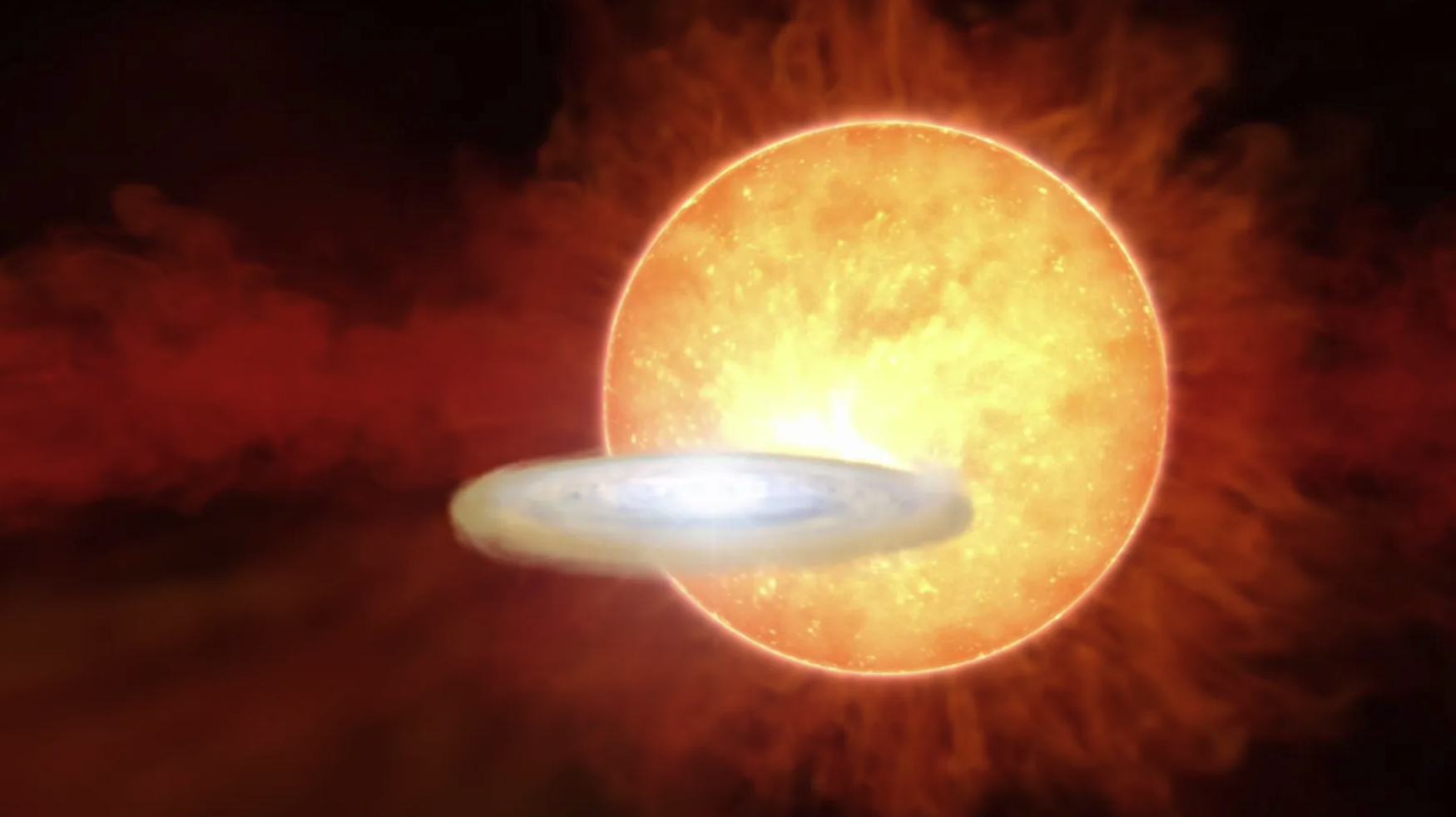
An illustration of T Coronae Borealis, two stars that orbit each other: a red giant nearing the end of its life and an Earth-sized stellar remnant known as a white dwarf. (Image credit: NASA's Goddard Space Flight Center Conceptual Image Lab)
A once-in-a-lifetime celestial event could occur in the coming days or months. If it does, the star system T Coronae Borealis (T CrB) will suddenly brighten, appearing as a “new star” in the night sky and potentially shining nearly as brightly as Polaris, the North Star.
Known as the Blaze Star, T CrB is an extremely rare type of system called a recurrent nova. It consists of a white dwarf and a red giant orbiting one another in a close binary system.
Over time, the white dwarf continuously pulls material from its red giant companion. As hydrogen accumulates on the white dwarf’s surface and reaches a critical threshold, a powerful thermonuclear explosion is triggered. This eruption can increase the system’s brightness by thousands or even tens of thousands of times. After the outburst, the white dwarf resumes drawing material from its companion, beginning the cycle once again.
Historical records indicate that T CrB erupts roughly once every 80 years. Astronomers have documented several such events over the past eight centuries, with the most recent eruption occurring in 1946. As a result, many researchers believe the system is now approaching its next outburst.
In early 2024, some astronomers predicted that an eruption might be imminent after observing brightness changes that closely resembled patterns seen before previous eruptions. However, despite multiple prediction attempts, T CrB has remained relatively quiet, and the expected outburst has yet to occur.
Even so, astronomers consider the system to be in an active state, and the eruption could happen at any time. When it does, T CrB is expected to brighten from its usual magnitude of around 10—far too faint to be seen with the naked eye—to approximately magnitude 2, making it visible without any optical aid and comparable in brightness to Polaris.
T Coronae Borealis is located in the constellation Corona Borealis, situated between Boötes and Hercules. The constellation forms a distinctive semicircular pattern resembling a crown. During the eruption, observers will see a bright “new star” appear within this crown-shaped constellation before gradually fading over the following days or weeks.
Recurrent novae are exceptionally rare, with only about five known examples currently identified in the entire Milky Way. As a result, the next eruption of T CrB is not only expected to be a spectacular sight for skywatchers, but also a valuable opportunity for astronomers to study white dwarf accretion, binary star evolution, and the physics of thermonuclear explosions.
If current expectations prove correct, the coming months may bring one of the most anticipated naked-eye astronomical events in recent years, as a “new star” briefly lights up the night sky in Corona Borealis.