...sometimes the only way to know if something works is to try it yourself.
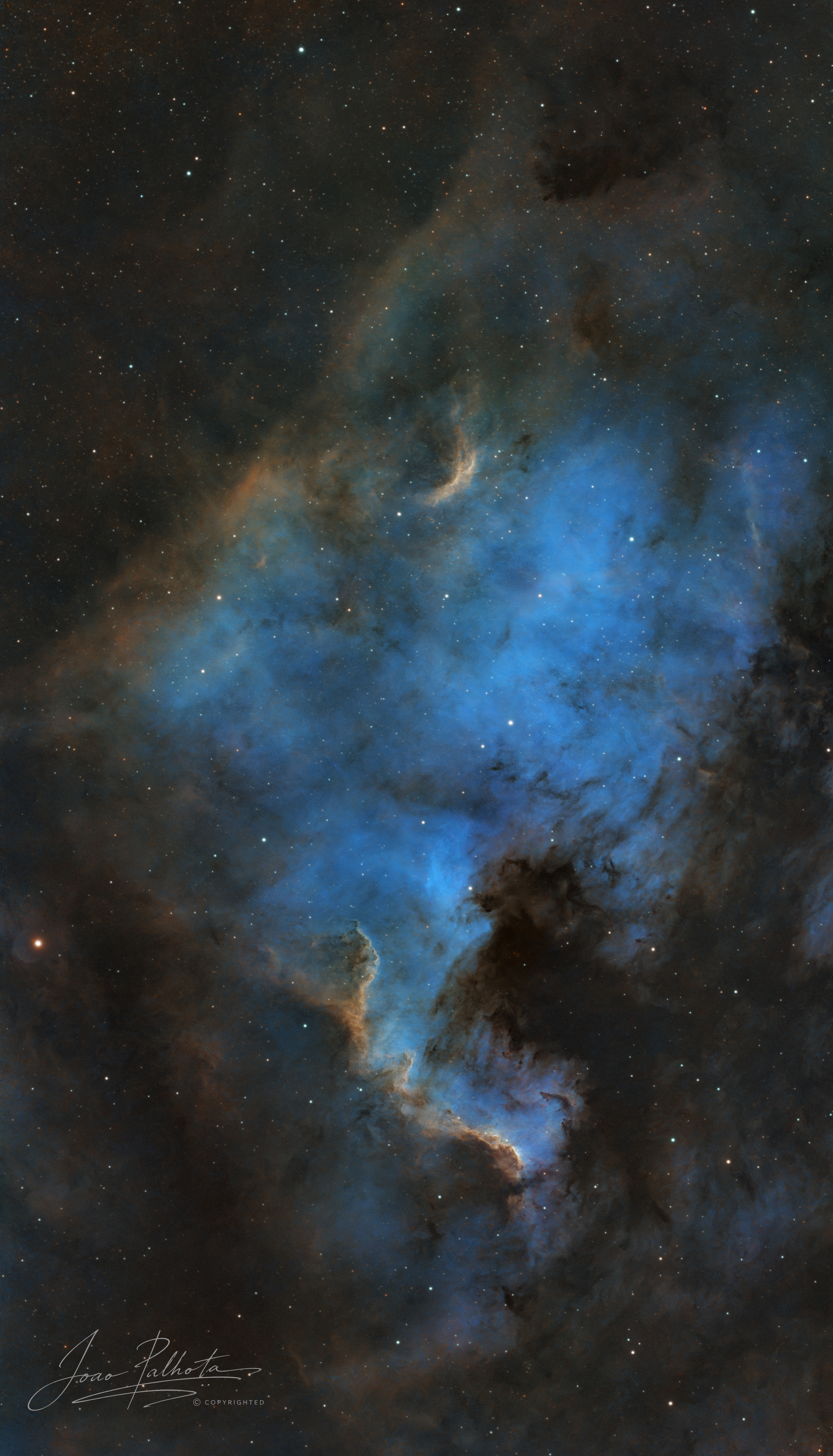
This is my second approach to NGC 7000, the North America Nebula, and probably one of the most demanding and rewarding projects I have processed so far.
The idea behind this image started with curiosity: could I push the Seestar setup further by combining its internal LP/Hα-OIII data with external Askar Colour Magic C1 and C2 dual-band filters?
After a lot of research online, I found many opinions suggesting that using the Askar C1 and C2 filters with this kind of setup would be unrealistic, difficult, or simply not worth it. In theory, it was almost an utopia.
So I decided to test it myself.
The result is this image.
It required many hours of capture, several stacking tests, careful registration between different masters, gradient correction, spectral/flux calibration, channel recombination and a lot of trial and error. The hardest part was making the data from different filters work together naturally without destroying the signal or creating an artificial look.
Integration details
Total integration time:
24h 40m 50s
Seestar LP / Hα-OIII:
741 frames
Mixed exposures of 20s, 30s and 60s
8h 15m 50s
Askar Colour Magic C1 / Hα-OIII:
242 frames × 60s
4h 02m
Askar Colour Magic C2 / OIII-SII:
743 frames × 60s
12h 23m
The final image is a combination of the Seestar LP/Hα-OIII data, the Askar C1 Hα/OIII signal and a recombined Askar C2 OIII/SII master, used to bring more separation, depth and structure to the nebula.
This project took a lot of dedication, research and experimentation, but it also proved something important to me: sometimes the only way to know if something works is to try it yourself.
Clear skies,
João Palhota