

JWST Finds Evidence That Supermassive Black Holes May Form Before Galaxies
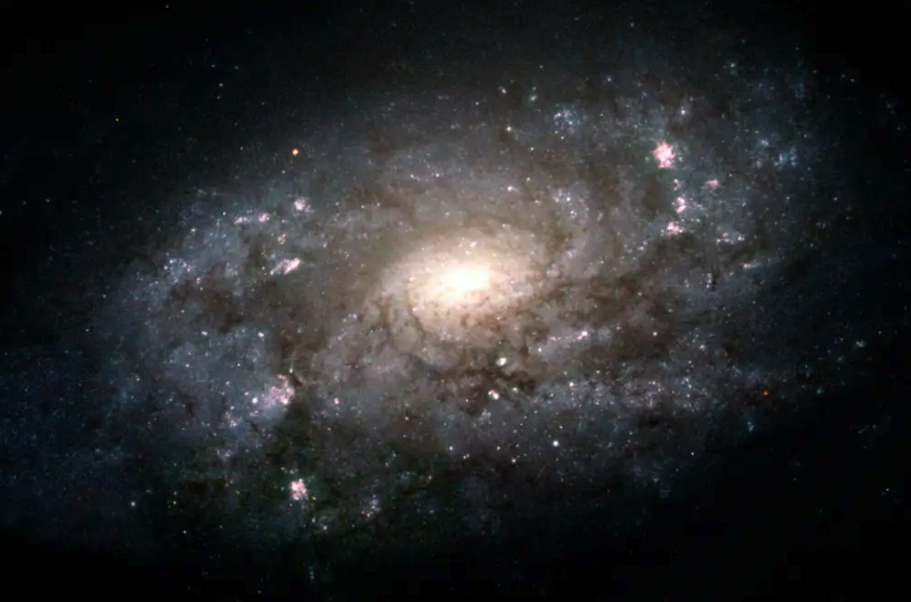
For decades, astronomers have debated a cosmic version of the classic “chicken-or-the-egg” question: which came first in the universe — galaxies or the supermassive black holes at their centers?
A new study may have brought us closer to an answer. Using observations from the James Webb Space Telescope (JWST), researchers have found a distant galaxy that existed just 700 million years after the Big Bang, whose central black hole accounts for nearly two-thirds of the galaxy’s total mass. The discovery suggests that, at least in this case, the black hole likely formed before the galaxy itself.
The object belongs to a newly identified class of early-universe systems known as Little Red Dots. These compact, reddish galaxies are found at extreme distances and often host unusually massive black holes. Since JWST began operations, astronomers have discovered hundreds of these objects, challenging existing models of galaxy formation and evolution.
The study focused on a galaxy designated QS01 (Abell 2744-QSO1). Thanks to a natural gravitational lens that magnified its light, researchers were able to make the first precise measurement of both the galaxy’s mass and the mass of its central black hole at such an early cosmic epoch.
Their analysis revealed that the black hole has a mass of approximately 50 million Suns, while the entire galaxy contains at most 75 million solar masses. In other words, the black hole makes up the majority of the system’s mass.
This is highly unusual compared with galaxies in the modern universe, where supermassive black holes typically represent only a small fraction of their host galaxy’s total mass. As a result, QS01 presents a significant challenge to conventional theories of galaxy growth.
According to the research team, only two scenarios currently appear capable of explaining the observation. One is direct collapse, in which a massive cloud of gas collapses directly into a black hole. The other is the more speculative primordial black hole hypothesis, which proposes that some black holes formed in the earliest moments after the Big Bang rather than from collapsing stars. In either case, the black hole would have formed before the galaxy.
While a single object is not enough to settle the debate, future observations of additional Little Red Dots could reveal whether QS01 is typical of the early universe. Such studies may provide crucial clues about how the first supermassive black holes emerged and how galaxies began to assemble around them.
If these findings are confirmed, astronomers may finally have an answer to one of cosmology’s oldest questions: in the early universe, the black hole may have come first.